



The best budget 4K TVs now give you much more than basic 4K resolution. For under $500, you can find Mini-LED backlights, quantum-dot color, local dimming, Dolby Vision, and even 144Hz gaming support.
For most buyers, the Hisense QD7 offers the strongest balance of picture quality and price. The Hisense U65QF makes more sense for gaming, while Vizio and TCL let you get a 65-inch screen for less. Current buying guides also favor these feature-rich budget models over basic entry-level LED sets.
Best Budget 4K TVs at a Glance
Prices below were checked against current U.S. retailer listings and recent reviews in August 2026. TV prices change often, so treat them as a buying reference rather than guaranteed checkout prices. Our related guide, Best Noise Cancelling Earbuds, goes further into this.
| TV | Best for | Size highlighted | Key display feature | Refresh rate | Smart platform | Price when checked |
| Hisense QD7 | Most buyers | 65-inch | Mini-LED / quantum-dot color | 60Hz | Fire TV | Under $500 |
| Hisense U65QF | Gaming and bright rooms | 55-inch | Mini-LED QLED | Up to 144Hz | Fire TV | Under $500 |
| Vizio Mini LED Quantum | Maximum size near $400 | 65-inch | Mini-LED Quantum | 60Hz at 4K | Vizio smart platform | About $358 |
| TCL QM5K | Premium features near $500 | 65-inch | QD-Mini LED | Up to 144Hz | Google TV | About $499.99 |
| Roku Select Series | Low price and easy streaming | 55-inch | QLED | 60Hz | Roku TV | About $249.99 |
Quick answer: For most buyers, the Hisense QD7 is the strongest all-around value under $500. Gamers should favor the 55-inch Hisense U65QF for its 144Hz panel and HDMI 2.1 support. If screen size matters most, the 65-inch Vizio Mini LED Quantum offers unusually strong hardware for its price.
1. Hisense QD7: Best All-Around value under $500
The Hisense QD7 is the easiest recommendation for a household that watches a mix of movies, shows, sports, and streaming video. Current buying guides place it among the strongest sub-$500 choices for most people.
Hisense combines quantum-dot color with local dimming, Dolby Vision, HDR10+, and built-in Fire TV. The current QD7 family is available in several screen sizes, including large options for living rooms.
The 65-inch and smaller versions use a 60Hz panel, so this isn’t the model to buy for high-frame-rate console gaming. Fire TV can also feel slower than the picture hardware deserves. Those tradeoffs are easier to accept when the set costs less than $500.
Pros: Good color, local dimming, broad HDR support, useful built-in audio, and a competitive price.
Cons: The smaller sizes are limited to 60Hz, and the Fire TV interface can feel sluggish.
Who should buy it: Pick the QD7 if you want a single affordable television for everyday viewing and don’t need 4K gaming at above 60 frames per second.
2. Hisense U65QF: Best Affordable Pick for Gaming
A cheap television can display a game in 4K without being a strong gaming display. Refresh rate, HDMI bandwidth, input lag, brightness, and variable refresh support matter too.
The 55-inch Hisense U65QF addresses several of those weaknesses. It supports refresh rates of up to 144Hz and includes two HDMI 2.1 inputs. Recent reviews also praise its brightness and strong value for gaming.
That makes it a better partner for a PlayStation 5, Xbox Series X, or capable gaming PC than most entry-level 60Hz televisions.
Its weaknesses are more visible when you watch from the side or examine demanding dark scenes. Reviews note some blooming and viewing-angle limitations. Fast motion can also expose picture-processing compromises.
Pros: 144Hz support, HDMI 2.1 connectivity, strong brightness, Mini-LED backlighting, and good HDR format support.
Cons: Narrower viewing angles, some blooming, and the Fire TV interface.
Who should buy it: Choose the U65QF when gaming features matter more than getting the largest screen possible.
3. Vizio Mini LED Quantum 65-inch: Best screen size near $400
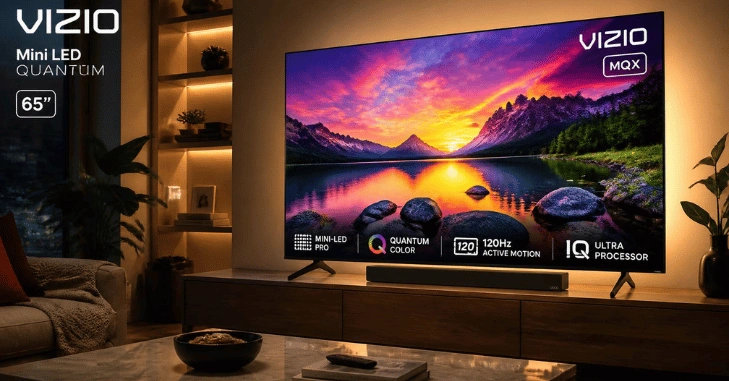
Vizio’s 65-inch Mini LED Quantum is one of the more unusual bargains in this group. Walmart listed the 2026 VQM65C series at about $358 at the time of checking, putting a 65-inch Mini-LED display below the prices of many smaller competitors.
Best budget 4K tVs The set supports Dolby Vision, HDR10+, and HLG. Testing also found solid HDR brightness and low input lag for its class. It displays 4K at 60Hz and can reach 120Hz when the resolution drops to 1080p.
You shouldn’t confuse that with a native 4K/120Hz gaming set. The more important benefit is the amount of screen and backlight hardware you get for the money. The smart interface is another compromise. Reviews have criticized its ad-heavy experience, though Vizio lets owners avoid much of the smart system by using an external streaming device instead.
If that sounds appealing, SciTechWiz’s Fire Stick vs. Roku comparison can help you choose between the two streamers.
Pros: Large 65-inch screen, Mini-LED backlight, broad HDR support, low input lag, and aggressive pricing.
Cons: Only 60Hz at 4K, noticeable blooming in difficult scenes, and a smart interface that won’t suit everyone.
Who should buy it: This is the value play for buyers who want a big living-room screen without spending close to $500.
4. TCL QM5K 65-inch: Best Feature Set Around $500
The TCL QM5K becomes especially attractive when the 65-inch version falls to $499.99. Best Buy listed the model at that price when checked, substantially below its previous selling price. Its QD-Mini LED panel gives the TV a stronger hardware foundation than a basic direct-lit LED model. It also supports high-refresh-rate gaming, variable refresh rate, and 4K at up to 144Hz. For a closer look at this, see Best 65 Inch TV.
Google TV is another reason to consider it. Buyers who dislike Fire TV may prefer Google’s app and content interface. Platform preference matters because you’ll interact with the home screen every day. SciTechWiz’s Fire TV vs. Roku guide is also useful if you’re comparing built-in platforms with a separate streaming player.
The catch is simple: this recommendation depends heavily on the sale price. At $500, the QM5K is compelling. If that discount disappears, compare it with Hisense models again before paying more.
Pros: 65-inch QD-Mini LED panel, 144Hz gaming support, VRR, Google TV, and strong value at its sale price.
Cons: The deal may not last, and spending the full $500 is unnecessary if you only stream casually.
Who should buy it: Choose the QM5K if you can get the 65-inch model for around $500 and want gaming features without dropping to 55 inches.
5. Roku Select Series 55-inch: Best Low-cost Streaming TV
Not every buyer needs Mini-LED or a 144Hz panel. If Netflix, YouTube, live TV, and casual console gaming make up most of your viewing, spending less can be the better choice.
The 2026 Roku Select Series keeps the focus on a simple smart-TV experience. Roku offers the 4K Select family in several sizes, while current 50-inch and larger models use QLED panels.
A current 55-inch Select Series listing was about $249.99 at the time of checking. The set runs at 60Hz and includes familiar Roku features such as voice control, Bluetooth connectivity, and game-oriented settings.
You give up the deeper local dimming and higher refresh rates found on the Hisense and TCL picks. In return, you keep hundreds of dollars in your pocket.
Pros: Low price, straightforward Roku software, QLED color, and plenty of screen space for bedrooms or smaller living rooms.
Cons: 60Hz refresh rate and less sophisticated backlighting than Mini-LED competitors.
Who should buy it: Buy the Roku if ease of use and low cost matter more than peak HDR quality or advanced gaming.
What Matters More Than The 4K Badge
Almost every television in this price class already has enough pixels. The larger differences come from how the screen controls light, handles motion, and connects to your devices.
Mini-LED and Local Dimming
Mini-LED backlights use many small light sources behind the LCD panel. Local dimming divides that light into controllable zones.
More precise control can improve contrast and HDR impact. It also helps bright highlights stand apart from darker parts of an image.
It isn’t OLED. Light can still spill into neighboring dark areas, causing blooming. Yet Mini-LED has become one of the most useful upgrades available at prices below those of premium TVs. Current budget recommendations increasingly feature the technology.
Refresh Rate and HDMI 2.1
A 60Hz panel is enough for movies, television shows, and casual gaming. Serious console and PC players should pay closer attention to 120Hz or 144Hz support.
HDMI 2.1 also matters when you want high-resolution, high-frame-rate signals from newer hardware. A high refresh rate alone doesn’t prove that every HDMI port supports the same capabilities.
Current TV-buying guidance recommends checking the refresh rate, input lag, gaming modes, and HDMI features rather than choosing a TV based on resolution alone.
The Smart Platform
A strong panel paired with software you dislike can become irritating fast.
Fire TV offers deep Amazon integration. Google TV has broad app support and strong search features. Roku is known for a simpler interface.
If you’re torn between two platforms, you don’t have to let software decide which television you buy. A separate streaming stick can later replace most built-in smart features.
55-inch vs. 65-inch: Where should your Budget Go?
At the same price, a smaller television can often include better panel, backlight, processor, or gaming hardware.
That tradeoff is clear here. The 55-inch U65QF gives gamers 144Hz support and HDMI 2.1. A similarly priced 65-inch model may favor size while using a simpler 60Hz panel.
Choose 55 inches when gaming performance, picture control, or a shorter viewing distance matters most.
Choose 65 inches when you sit farther away, watch movies with several people, or want a more immersive living-room image.
If your room can support something far larger, a television isn’t the only option. SciTechWiz also explains what to consider with a short-throw 4K projector.
Are TVs under $500 worth Buying?
Yes, as long as you buy for your use case instead of chasing a premium logo. Current market guides show that $300 to $500 can get you good 55-inch and 65-inch LED, QLED, and Mini-LED choices. What you normally won’t get at this price is a mainstream OLED television. OLED sets still tend to start at much higher prices, even during promotions.
Budget sets also cut costs somewhere. Common compromises include narrower viewing angles, weaker speakers, slower processors, fewer HDMI 2.1 ports, and less refined local dimming. The goal isn’t to find a television with no weaknesses. It’s to pay for the strengths you’ll notice every day.
The verdict
Buy the Hisense QD7 if you want the safest all-purpose choice below $500. It balances color, HDR support, local dimming, and everyday usability without forcing you into a smaller screen. For gaming, choose the 55-inch Hisense U65QF instead. Its 144Hz capability and HDMI 2.1 ports are worth more than extra screen size when high-frame-rate play is the priority.
Best budget 4K tVs If your goal is maximum screen size per dollar, check the 65-inch Vizio Mini LED Quantum first. The TCL QM5K is the better step-up choice when its 65-inch version stays near $500.
Before ordering, verify the exact model number, current price, screen size, refresh rate, and HDMI ports. Retailers often place similarly named models side by side, and sale prices can change quickly. Once the screen is sorted, compare your live TV options with SciTechWiz’s YouTube TV vs. Fubo guide to ensure the service is compatible with the hardware you bought.
Frequently Asked Questions
The Hisense QD7 is a strong choice for general viewing, while the Hisense U65QF suits gamers better. The Vizio Mini LED Quantum offers exceptional value at 65 inches for around $400, and the TCL QM5K becomes attractive at around $500. Buyers who prioritize simplicity can spend much less on the Roku Select Series.
It can be. Mini-LED gives an LCD television more precise backlight control, which can improve contrast and HDR presentation. The upgrade matters most for movies, HDR shows, and rooms where you want a brighter image. A basic LED set can still make sense for casual viewing.
The Hisense U65QF is the strongest gaming-focused pick here because its 55-inch model supports up to 144Hz and includes HDMI 2.1 inputs. The TCL QM5K is another strong option when its 65-inch model is discounted to around $500.
Not as a typical new TV purchase in the U.S. market. Current OLED models typically remain well above $500, even though discounts sometimes bring entry-level models closer to $1,000.
Yes, especially when the display hardware is good, but you dislike its built-in software. An external Roku, Fire TV, or similar player can extend the set’s smart features’ useful life.
Choose the larger screen when immersion and viewing distance matter more than advanced gaming features. Choose the better 55-inch panel when refresh rate, HDMI 2.1, brightness, or local dimming matters more.