


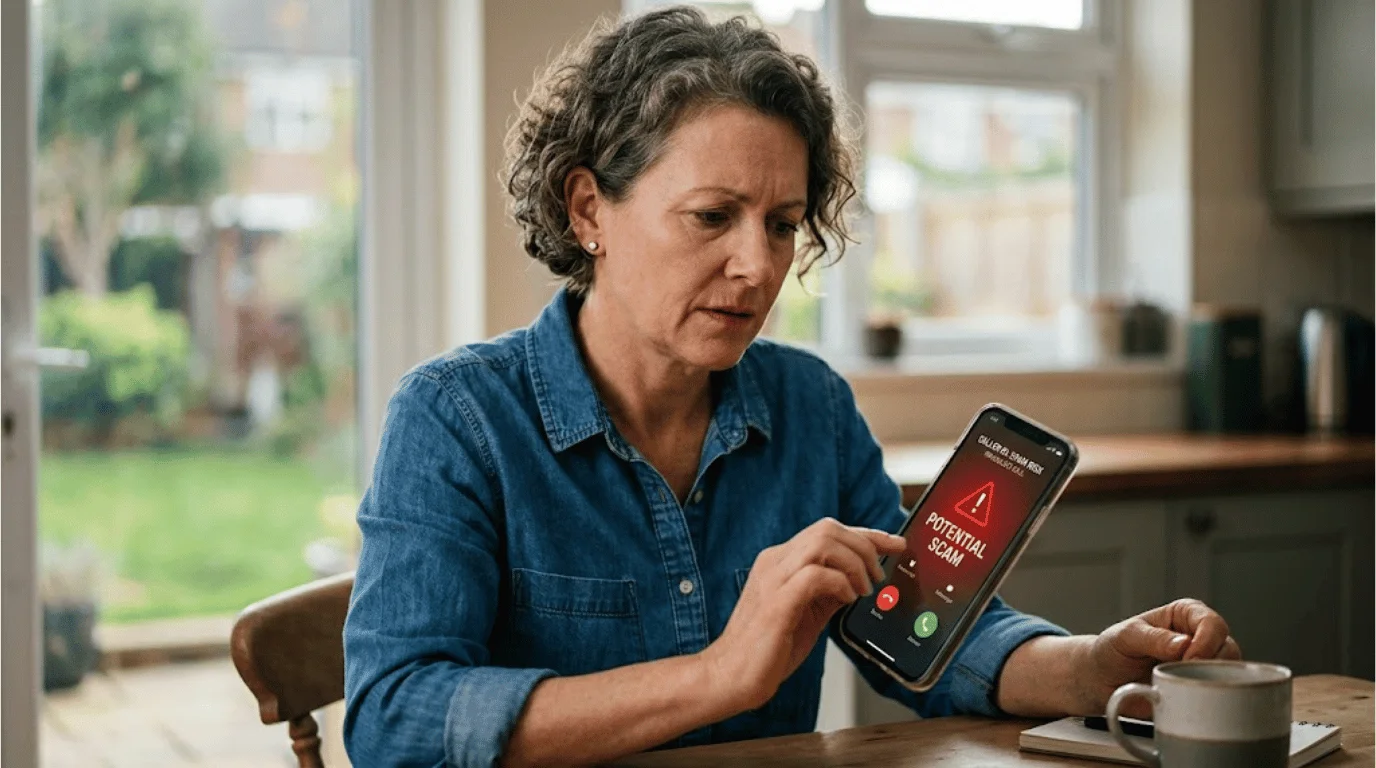
If your phone shows Spam Risk when an unfamiliar number calls, your carrier believes the call may be unwanted or suspicious. The warning doesn’t prove the caller is a scammer, because legitimate numbers can sometimes be flagged too. For most unknown flagged calls, letting the caller leave a voicemail is the safer choice.
| What to know | Quick answer |
|---|---|
| Who adds the warning? | Usually your wireless carrier or a call-identification service |
| Does the label prove fraud? | No, it is a risk assessment rather than a final determination |
| Should you answer? | Let unfamiliar flagged callers go to voicemail when possible |
| Can legitimate calls be flagged? | Yes, especially numbers with unusual or high-volume calling patterns |
| Can caller ID be faked? | Yes, scammers can spoof the number shown on your screen |
| Best next step | Verify important callers through an official number you already trust |
Quick answer: A carrier warning means an incoming number has matched signals associated with unwanted or suspicious calling. Systems may consider complaints, calling behavior, number reputation, and authentication data. If you do not recognize the caller, let the call go to voicemail and verify any important request through a trusted contact method.
Key Takeaways
- A warning label is useful, but it is not proof that a specific caller is committing fraud.
- AT&T, Verizon, and T-Mobile use different labels and filtering tools.
- Caller ID can be spoofed, so a familiar-looking number is not enough to establish trust.
- Never provide passwords, verification codes, banking details, or a Social Security number simply because an unexpected caller asks.
- The National Do Not Call Registry may reduce lawful sales calls, but it does not stop criminals who ignore the rules.
- Carrier filtering, device blocking, voicemail, and independent verification work better together than relying on a single warning.
What the Caller ID Warning Actually Means
Wireless networks use call-labeling systems to help customers identify numbers that may be associated with unwanted calling. These systems can evaluate complaint reports, recent calling patterns, number reputation, and other network signals. AT&T, for example, says ActiveArmor can label or block calls partly based on customer complaints and feedback.
The key distinction is that a warning is a prediction, not a legal finding about the caller. AT&T also acknowledges that its service may sometimes misidentify wanted calls. Verizon similarly provides a process for reporting legitimate numbers that were categorized incorrectly.
That possibility explains why a medical office, delivery service, school, contractor, or other real organization might occasionally appear suspicious. You should still treat an unexpected call cautiously, but you do not need to assume every flagged number belongs to a criminal. Verification is safer than either trusting the caller immediately or dismissing every call without checking.
Why a Spam Risk Call Gets Flagged
A number can develop a poor reputation when its recent behavior resembles patterns commonly associated with unwanted calling. Networks do not publicly reveal every factor or weighting in their detection systems. Still, carrier information and current industry guidance point to several common signals.
These commonly include the following.
- Repeated consumer complaints about a number.
- Unusually high outbound calling volume.
- Calling patterns associated with automated dialing.
- Reports identifying a number as telemarketing or fraud.
- Caller-ID authentication information.
- Previous reputation data attached to a reassigned number.
- Suspicious behavior associated with spoofed calls.
A legitimate business can therefore be caught by an automated filter when its calling behavior resembles mass outreach. That doesn’t mean you should ignore the warning, because filtering systems exist to give you useful information before you answer. It means the safest response is to combine the label with voicemail, context, and independent verification.
How Major U.S. Carriers Label Suspicious Calls
The wording on your screen depends partly on your carrier. AT&T provides ActiveArmor, Verizon provides Call Filter, and T-Mobile provides Scam Shield protections. If carrier features matter when choosing service, SciTechWiz’s cell phone plan comparison offers additional context on evaluating U.S. wireless providers.
| Carrier | Examples of labels | Carrier tool |
|---|---|---|
| AT&T | Spam Risk, Fraud Risk | ActiveArmor |
| Verizon | Potential Spam, Potential Fraud, Robo Caller | Call Filter |
| T-Mobile | Scam Likely, Potential Spam and other categories | Scam Shield |
AT&T says customers can choose how some labeled calls are handled through ActiveArmor. Verizon describes Potential Spam as calling that may be indiscriminate or inappropriate, while its Potential Fraud category indicates stronger concern. T-Mobile says Scam ID automatically displays “Scam Likely” when its network identifies a suspected scam call.
These differences explain why the same caller may not receive identical treatment on every network. One carrier may display a warning while another lets the call appear normally. Treat caller labeling as one layer of protection rather than a universal verdict.
Should You Answer a Flagged Call?
If you don’t recognize the number and aren’t expecting a call, voicemail is usually the simplest screening tool. A legitimate business, doctor’s office, delivery company, recruiter, or service provider can leave enough information for you to determine why it called. You can then contact the organization through a number from its official website, app, bill, account statement, or another trusted source.
If you answer and become suspicious, hang up instead of arguing with the caller or following instructions. The Federal Trade Commission advises people who receive illegal robocalls not to press buttons or call back simply because a recording offers an unsubscribe option. The FTC also warns that caller ID information can be faked.
Simply seeing a familiar local area code is therefore not enough to prove identity. Scammers can use caller-ID spoofing to make a call appear to come from a nearby person, business, or government office. If money, credentials, or sensitive information are involved, end the incoming call and initiate a new one yourself.
How to Verify an Important Caller Safely
Verification works best when you control the second contact. Do not rely on a callback number an unexpected caller provides, because it may lead back to the same operation. Use information you already know is connected to the organization.
- Let the call reach voicemail. Listen for a name, organization, purpose, and callback instructions, but don’t take immediate action.
- Find the official contact independently. Use the organization’s official website, mobile app, card, statement, or saved contact.
- Call through that verified channel. Ask whether the organization tried to reach you and why.
- Keep security codes private. Do not provide one-time passwords, account passwords, card PINs, or authentication codes to someone who called you unexpectedly.
- End high-pressure conversations. Urgent threats, unusual payment requests, or demands to stay on the line are reasons to stop the call and verify separately.
This process takes slightly longer than trusting caller ID, but it reduces the advantage that impersonation scams depend on. It also protects you from false positives because you can still reach a legitimate caller through an official channel. The goal is not to fear every unknown number; it is to make identity verification independent of the incoming call.
How to Reduce Unwanted Calls in the U.S.
Start with the filtering options your carrier already provides. AT&T offers ActiveArmor features, Verizon offers Call Filter, and T-Mobile customers can use Scam Shield controls to identify or block certain categories of unwanted calls. Carrier settings change over time, so check the current support page for your plan rather than relying on an old menu walkthrough.
You can also block individual numbers through your phone after receiving an unwanted call. Device menus vary by iPhone model, Android version, and manufacturer interface, but the Phone or Recents screen usually provides blocking or reporting controls. If the problem is call audio rather than caller identification, SciTechWiz also has a wired earphones guide for calls and everyday use and an AirPods Pro troubleshooting and reset guide.
U.S. consumers can register eligible home and mobile numbers with the National Do Not Call Registry at no charge. The FTC explains that the registry is intended to reduce unwanted sales calls from companies that follow the law, but it does not physically block incoming calls. Criminal callers can ignore the registry, so filtering and careful verification remain necessary.
What STIR/SHAKEN Does and Does Not Tell You
U.S. phone networks also use caller-ID authentication technology known as STIR/SHAKEN. Federal rules require covered voice providers to implement the framework in applicable IP networks, allowing providers to authenticate and verify caller identification information. The system helps combat spoofing by creating a chain of trust around the caller-ID information traveling with a call.
Authentication should not be confused with a guarantee that the person speaking is trustworthy. A call can come from an authenticated number and still contain an unwanted sales pitch, deceptive request, or other harmful behavior. Think of authentication as evidence about the displayed number, while call labeling considers broader reputation and behavior signals.
What If Your Own Number Is Being Flagged?
Businesses sometimes discover that customers see warnings when they call. A false label can happen after consumer reports, unusual calling patterns, number reassignment, or other reputation problems. The first step is to check which carrier or screening service is applying the warning, rather than repeatedly changing caller-ID settings.
Businesses should also review their outbound calling practices. Sudden volume spikes, large numbers of unanswered calls, and repeated short calls can resemble automated outreach patterns. T-Mobile, for example, points businesses to a caller-registration service, while Verizon provides a feedback route for numbers that were incorrectly identified.
Fixing the reputation issue is more useful than disguising the number. Keep caller identity consistent, honor consent and opt-out requirements, and avoid calling patterns that create unnecessary complaints. Legitimate organizations also benefit from clearly identifying themselves and leaving useful voicemail messages when customers do not answer.
Frequently Asked Questions
Is every Spam Risk call a scam?
No, the label is not proof that a specific call is fraudulent. Automated systems can occasionally categorize legitimate businesses or other wanted callers incorrectly. If the call might matter, let it reach voicemail and verify the organization through an official contact method.
Why am I suddenly receiving more flagged calls?
Your number may have entered new marketing lists, appeared in public data, or started receiving calls from campaigns using large pools of numbers. The FTC has warned that information submitted to online forms can sometimes be sold or passed to telemarketers. A sudden increase doesn’t necessarily mean your phone has been hacked.
Does blocking one number stop future unwanted calls?
Blocking a specific number prevents that number from contacting you through the normal calling route on many devices. It cannot stop another caller from using a different number or a spoofed identity. Carrier-level filtering is therefore useful alongside individual blocking.
Does the Do Not Call Registry stop scam calls?
No, the registry does not block phone calls and cannot force criminals to follow U.S. telemarketing rules. It mainly stops unwanted sales calls from legitimate companies that comply with the law. The FTC recommends call blocking and labeling tools as additional defenses against illegal and unwanted calls.
What should I do if a caller claims to be my bank or a government agency?
Do not provide account credentials, verification codes, or payment information during an unexpected call. Hang up and contact the organization through a trusted number from its official website, app, statement, or card. This approach protects you even when the caller ID displays a familiar organization or local number.
The Bottom Line
A suspicious caller label is useful because it gives you a chance to screen a call before trusting the person behind it. Let unfamiliar calls reach voicemail, verify important requests independently, and use your carrier’s filtering tools to reduce interruptions. If a caller asks for sensitive information, money, passwords, or security codes, end the call and contact the organization yourself through a verified channel.