

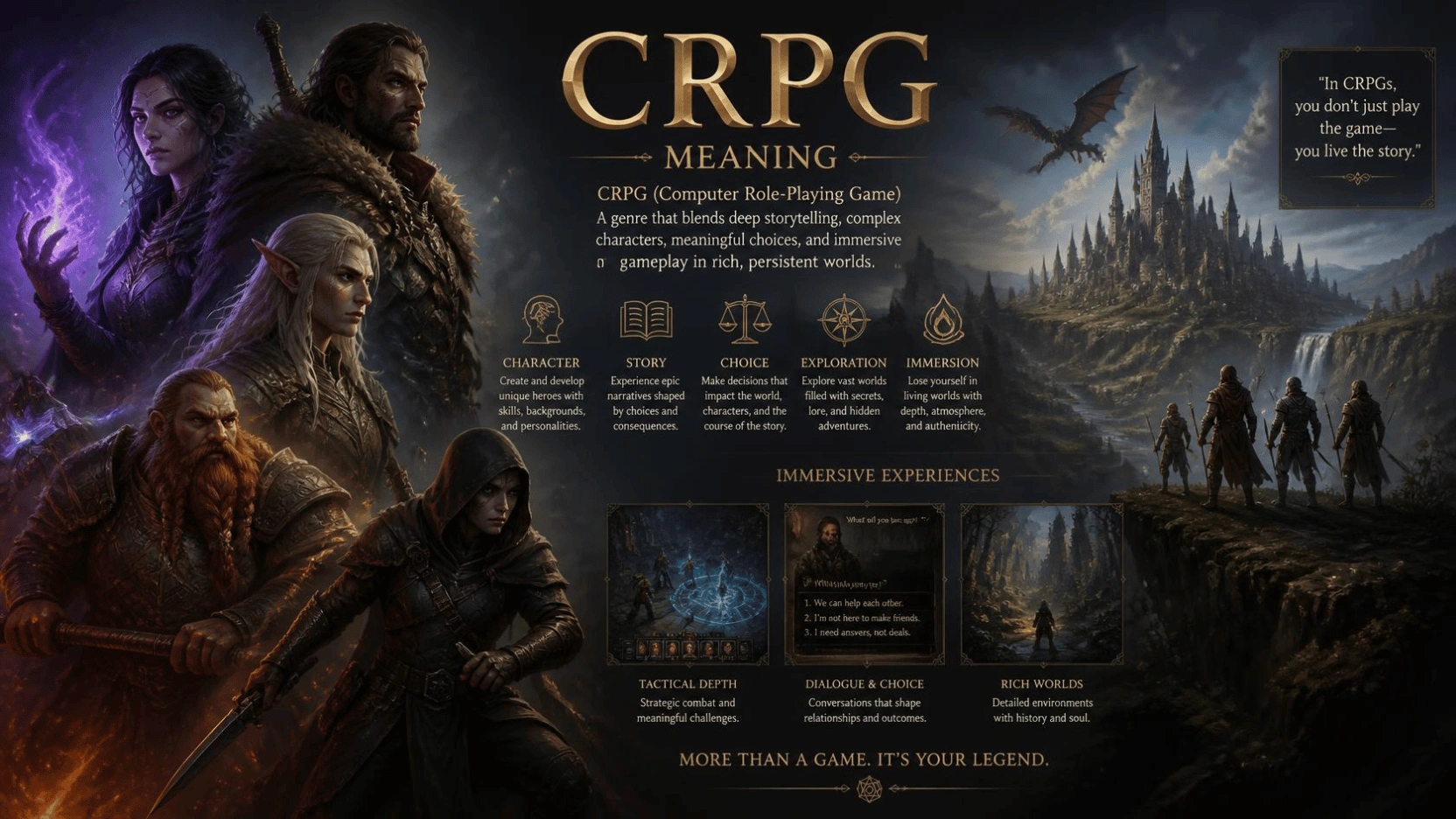
The meaning of CRPG is simple at its core: CRPG stands for computer role-playing game. CRPG meaning Today, the label usually describes a tabletop-inspired video game built around character statistics, choices, dialogue, party management, and rules-driven combat. In modern gaming, the term is narrower than its literal meaning suggests.
The name comes from the early days of role-playing video games, when developers adapted tabletop game ideas to computers. Early titles such as Ultima and Wizardry helped establish systems based on character attributes, equipment, exploration, quests, and tactical decisions.
| Key point | What it means |
| CRPG stands for | Computer role-playing game |
| Genre roots | Tabletop role-playing games such as Dungeons & Dragons |
| Main focus | Character builds, statistics, choices, quests, and strategy. |
| Common combat | Turn-based or real-time with pause |
| Typical viewpoint | Often isometric or top-down, but not required |
| Platforms | PC, consoles, and other supported devices |
| Well-known examples | Baldur’s Gate 3, Pathfinder, Pillars of Eternity, Planescape: Torment |
What CRPG Meaning Covers in Modern Gaming
The literal definition could describe almost any role-playing game played on a computer. Modern players usually use the term more selectively.A modern CRPG often tries to reproduce some of the freedom and rule-based decision-making associated with tabletop role-playing games. Character statistics may affect attacks, dialogue checks, skills, exploration, and other outcomes. Player choices can also change quests, relationships, or story paths.
CRPG meaning This narrower usage explains why simply installing an RPG on a PC does not automatically classify it as a subgenre. Likewise, a console version of a game such as Baldur’s Gate 3 does not cease to belong to the same genre. The label now describes a style of game design more than the machine on which the game runs.
What Makes a Game a CRPG?
No single feature creates a strict boundary. Genre labels are flexible, and individual games often combine ideas from several categories. Still, these seven traits appear frequently in games commonly placed in this group.
- Detailed character progression. Players develop attributes, skills, classes, abilities, equipment, or other statistics that affect what their characters can do.
- Rules-driven outcomes. Success often depends on character statistics, abilities, dice rolls, or other underlying systems rather than on reflexes alone.
- Meaningful dialogue choices. Conversations may offer several responses, skill checks, persuasion options, or decisions that affect later events.
- Party management. Many games let you control several companions with different strengths, weaknesses, classes, and roles.
- Tactical combat. Battles often reward positioning, combination of abilities, resource management, and planning. Combat may be turn-based or real-time with pause.
- Quest and problem-solving freedom. A situation may allow for combat, negotiation, stealth, skill checks, exploration, or another solution.
- Strong tabletop influence. Many systems borrow ideas from pen-and-paper role-playing games, including classes, attributes, dice rolls, parties, quests, and branching decisions.
Baldur’s Gate 3 is a useful modern example. Its official site describes turn-based combat built on the Dungeons & Dragons 5e ruleset, with modifiers, initiative, environmental interactions, and strategic choices.
CRPG vs RPG, ARPG, and JRPG
The easiest way to understand the genre is to compare its usual priorities with those of other role-playing game categories.
| Genre | Typical focus | Combat style | Player experience |
| CRPG | Statistics, choices, party systems, tabletop-style rules | Turn-based or real-time with pause | Strategic and system-heavy |
| RPG | Broad umbrella for role-playing games | Varies widely | Character progression and role-playing |
| ARPG | Fast action and direct control | Real-time | Reflexes and combat execution matter more |
| JRPG | A broad tradition associated with Japanese RPG design | Turn-based, action, or hybrid | Often party-focused with structured progression |
The boundaries are not absolute. RPG is the broadest term, while the other labels identify particular traditions or gameplay styles. Action RPGs usually place greater emphasis on real-time input and player execution. Computer role-playing games tend to place more emphasis on character systems and strategic decisions.
That is also why perspective alone does not determine the genre. An isometric camera is common, especially in games inspired by the classic Baldur’s Gate titles, but it is a visual choice rather than a defining characteristic.
If you want more of this kind of explainer, SciTechWiz’s gaming guides and genre breakdowns cover the surrounding territory, and its guide to virtual reality headsets looks at a very different way of playing.
Are These Games Always Turn-Based?
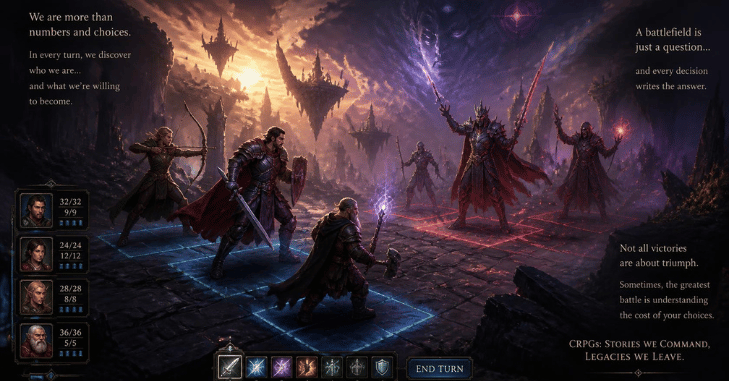
No. Turn-based combat is common but not mandatory.Some titles use real-time combat with pause, often shortened to RTwP. This system lets the action continue in real time while giving players the option to pause, issue commands, and plan the party’s next moves.
Pathfinder: Wrath of the Righteous, for example, supports both real-time-with-pause and turn-based gameplay. Owlcat has explained that turn-based mode gives players tighter control over individual party actions and brings combat closer to a tabletop experience.
Pillars of Eternity is another example of how these systems can overlap. Obsidian added an official turn-based option alongside its real-time-with-pause system, showing that a single game can support both approaches.
Classic and Modern Games That Show the Genre Clearly
Older computer role-playing games include Ultima, Wizardry, Fallout, Baldur’s Gate, Planescape: Torment, and Arcanum. These titles helped establish many of the systems associated with the genre, including detailed character sheets, inventory management, party control, dialogue, and tactical encounters.
Modern examples include Baldur’s Gate 3, Pathfinder: Wrath of the Righteous, Pillars of Eternity, Disco Elysium, and Solasta: Crown of the Magister. They do not all play the same way, which helps illustrate how broad the category can be.
Beginners who want a clear tabletop connection may find Baldur’s Gate 3 conceptually easy to understand because its rules are based on D&D 5e. Players who enjoy more complex character-building systems may prefer the Pathfinder games.
Do You Have to Play One on a Computer?
No. The historical name can be misleading.Many games identified with this genre now appear on consoles as well as PCs. The important point is the design style, not whether you use a keyboard, a controller, a desktop computer, or a console.That also means the “C” should not be treated as a platform restriction. It is better understood as a historical part of the genre’s name.
The Simple Way to Remember It
Think of these games as tabletop-style role-playing translated into a video game system. The computer handles rules, calculations, enemies, and the game world, while you make decisions about characters, dialogue, exploration, combat, and story choices.
You do not need to memorize a rigid genre definition. If a role-playing game gives character statistics and player decisions more weight than reflex-based action, uses deep party or dialogue systems, and feels influenced by tabletop rules, the label will usually make sense.
To keep exploring gaming topics, visit SciTechWiz’s Gaming coverage. The site also publishes individual game guides, such as its Basketball Zero codes article, for players looking for practical, game-specific help.
Conclusion
The CRPG meaning is best understood as computer role-playing game, but in modern gaming the term usually refers to a specific tabletop-inspired style of RPG. These games place strong emphasis on character statistics, meaningful choices, dialogue, party management, tactical combat, and rules-driven outcomes.
Games such as Baldur’s Gate 3, Pathfinder: Wrath of the Righteous, and Pillars of Eternity show how varied the genre can be. Some use turn-based combat, while others use real-time with pause, but they share a greater focus on strategy, character development, and player decision-making than many action-focused RPGs.
Frequently Asked Questions
It means computer role-playing game. In current gaming discussions, the term usually refers to a tabletop-influenced RPG with detailed character statistics, player choices, party systems, dialogue, and strategic or rules-based gameplay.
Yes. It is a party-based role-playing game based on the Dungeons & Dragons 5e ruleset. Its official description highlights turn-based combat, initiative, roll modifiers, character creation, and strategic interaction with the environment.
No. Isometric and top-down views are common, especially among games influenced by older PC RPGs, but camera angle alone does not define the genre.
They can have more rules, statistics, abilities, and choices to learn than action-focused games. Modern titles often make these systems easier to understand through tutorials, difficulty settings, clearer interfaces, and controller support. Baldur’s Gate 3, for example, includes multiple difficulty options.
No. In modern usage, the term usually describes a specific tabletop-inspired style rather than every role-playing title that happens to run on a personal computer.