


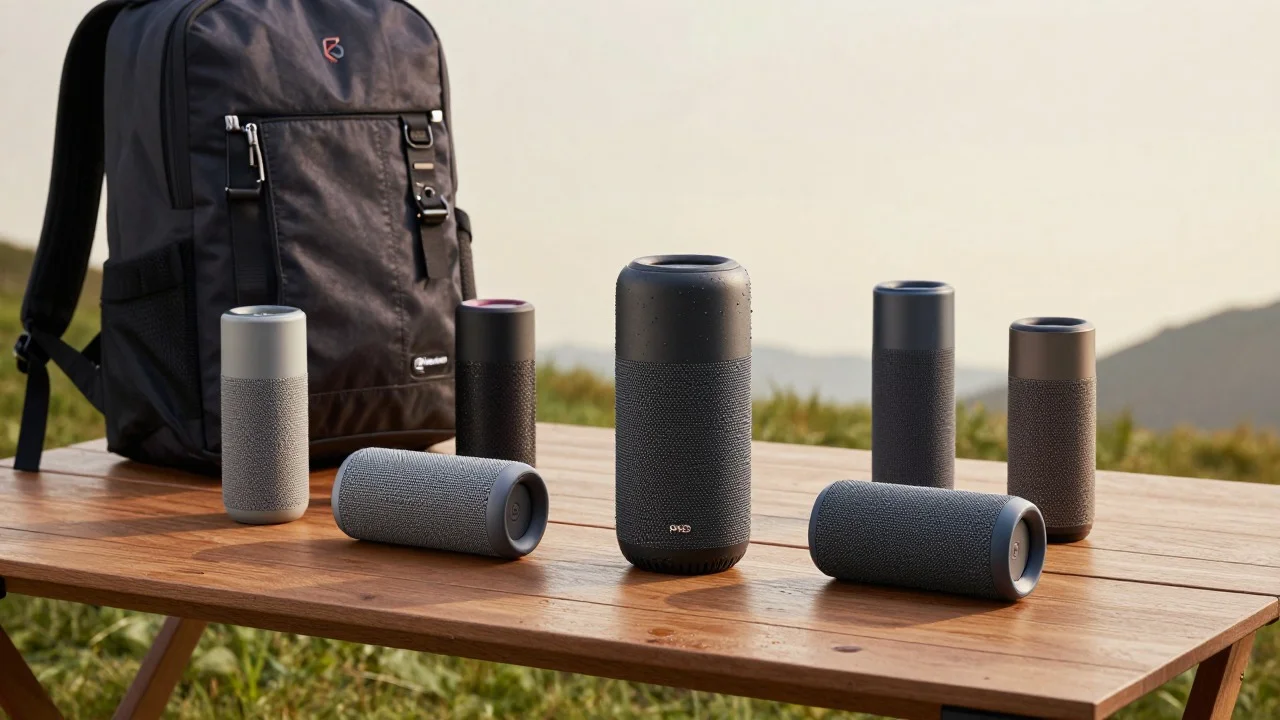
Shopping for the best portable speakers is mostly a question of trade-offs: size, sound, battery life, and weather protection. Current expert roundups disagree on a single winner, which is useful because different models excel in different situations. This guide narrows the field to seven picks with clear reasons to choose each one.
Quick answer: For most buyers in 2026, the JBL Charge 6 is the strongest all-around choice. It combines 24-hour rated battery life, IP68 protection, a built-in power bank, and a size that still works well for day trips. Choose the Flip 7 or Wonderboom 4 if lower weight matters more than bass and output.
| Speaker | Best for | Rated battery | Protection | Standout feature |
|---|---|---|---|---|
| JBL Charge 6 | Best overall | 24 hours, up to 28 with boost | IP68 | Built-in power bank |
| JBL Flip 7 | Lighter everyday carry | 14 hours, up to 16 with boost | IP68 | Compact design and carabiner |
| Bose SoundLink Flex 2 | Compact sound quality | Up to 12 hours | IP67 | PositionIQ and 1.3-pound body |
| UE Wonderboom 4 | Pool and beach use | Up to 14 hours | IP67 | Floats in water |
| Marshall Kilburn III | Long battery life | 50+ hours | IP54 | Wide 360-degree sound |
| Tribit StormBox Micro 3 | Budget travel | Up to 24 hours at 50% volume | IP68 | Strap, magnetic mount, 0.73-pound weight |
| Soundcore Boom 3i | Rugged outdoor trips | Up to 16 hours | IP68 | 50W output and saltwater resistance |
JBL lists IP68 protection for both the Charge 6 and Flip 7. Their standard battery ratings are 24 and 14 hours, respectively. Playtime Boost can extend those figures to 28 and 16 hours.
Bose rates the SoundLink Flex 2 for 12 hours and IP67 protection. Ultimate Ears gives the Wonderboom 4 a 14-hour rating and says it floats. Tribit and Soundcore publish IP68 ratings for their outdoor-focused models.
Key Takeaways
- JBL Charge 6 offers the best balance for most buyers.
- JBL Flip 7 makes more sense when bag space matters.
- UE Wonderboom 4 is an easy pick for pools and beaches.
- Marshall Kilburn III leads this group in rated battery life.
- Tribit StormBox Micro 3 packs useful travel features into a much smaller body.
- Soundcore Boom 3i is built for rougher outdoor and waterside use.
The 7 Portable Speaker Picks Worth Considering
1. JBL Charge 6: Best Overall
The Charge 6 sits in a useful middle ground. It is more substantial than pocket-sized models without becoming a large party speaker.
Its IP68 rating suits beach days, campsites, and poolside use. A 24-hour standard battery rating also reduces the need to pack a charger for shorter trips. The built-in power bank can charge another device.
What Hi-Fi currently rates the Charge 6 as its top waterproof choice. That supports its position here as the safest all-purpose recommendation rather than a specialist pick.
Pros: Long battery life, strong weather protection, a useful power-bank function, and a versatile size.
Cons: It is larger than true grab-and-go models, so frequent flyers may prefer something smaller.
2. JBL Flip 7: Best for Everyday Carry
Choose the Flip 7 if you like JBL’s approach but don’t need the Charge 6’s larger battery or power-bank feature.
JBL rates it for 14 hours of standard playback, with up to two extra hours through Playtime Boost. It also carries an IP68 rating and includes a carabiner.
What Hi-Fi singles it out as a strong portable option in its current waterproof-speaker recommendations. That mix of durability and easier portability makes it a better travel companion for many users.
Pros: Compact shape, IP68 protection, easy attachment, and solid battery life.
Cons: The smaller enclosure cannot match the scale of larger models.
3. Bose SoundLink Flex 2: Best Compact Sound
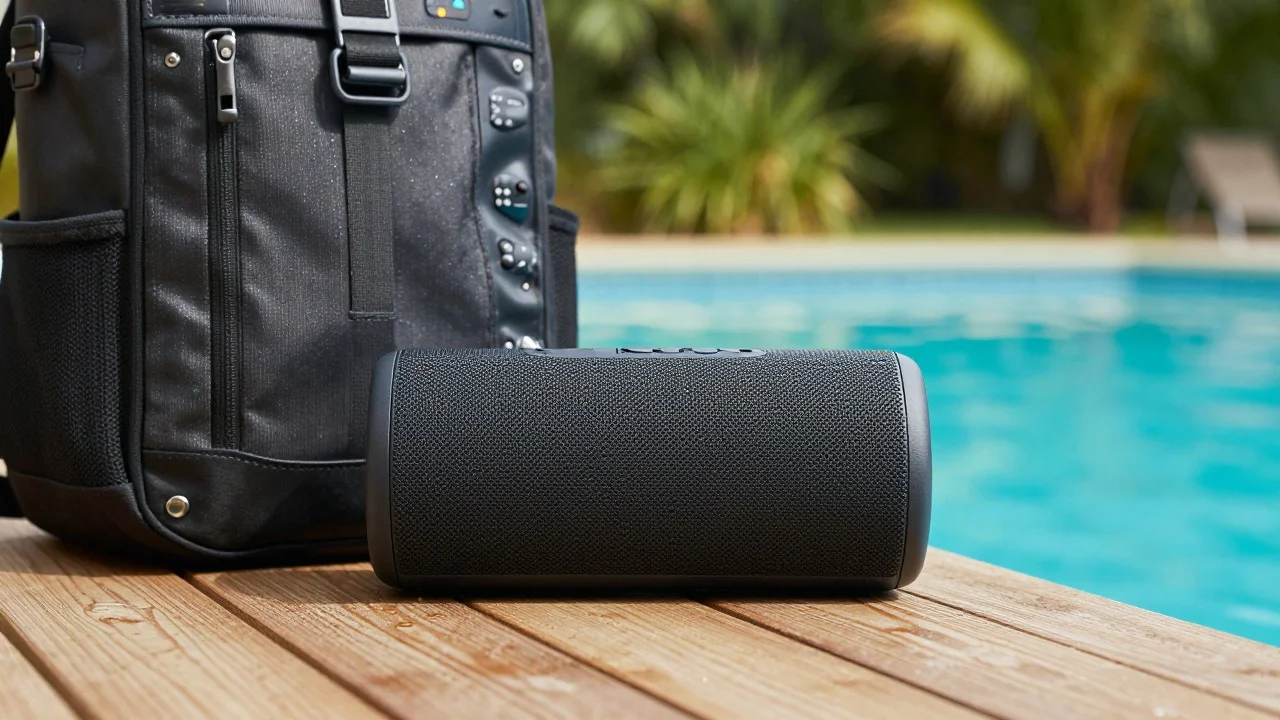
The SoundLink Flex 2 suits listeners who care about sound but still want a speaker that disappears into a backpack.
Bose lists a weight of about 1.3 pounds, 12-hour battery life, IP67 protection, and PositionIQ. That feature adjusts the audio according to the speaker’s orientation. It also floats.
WSJ Buy Side highlighted the Flex 2 for its bass performance among the portable models it tested. Its trade-off is shorter rated battery life than the JBL Charge 6 or Tribit Micro 3.
Pros: Compact body, strong bass for its size, orientation-aware sound, and IP67 protection.
Cons: Twelve hours of rated playback is modest compared with several rivals here.
4. Ultimate Ears Wonderboom 4: Best for Pools and Beaches
The Wonderboom 4 is a simple choice for places where a speaker is likely to get wet.
Ultimate Ears rates it at IP67 with up to 14 hours of playtime. More importantly for pool use, the company says the speaker floats. Two units can also form a left-right stereo pair.
WSJ Buy Side placed it first among the portable models in its sub-$200 comparison, citing its balanced sound, durability, and floating design.
Pros: Floating design, compact shape, straightforward controls, and good water protection.
Cons: Buyers who want deeper bass or a power-bank feature should look elsewhere.
5. Marshall Kilburn III: Best for Battery Life
The Kilburn III is less backpack-friendly than the smallest options, but it rewards the extra bulk with exceptional rated endurance.
Marshall advertises more than 50 hours of playback. It also uses a 360-degree stereo arrangement and can recharge a phone. Its IP54 rating protects against limited water and dust exposure rather than full immersion.
This makes it a better fit for patios, cabins, long weekends, and moving between rooms than for kayaking or poolside use.
Pros: Exceptional battery rating, broad sound dispersion, physical controls, and charge-out support.
Cons: IP54 protection is weaker than the IP67 and IP68 ratings found on several smaller rivals.
6. Tribit StormBox Micro 3: Best Budget Travel Pick
The StormBox Micro 3 stands out because its small size doesn’t strip away practical travel features.
Tribit lists a weight of 0.73 pounds, IP68 protection, 13W output, a silicone strap, and a magnetic mounting system. Its 24-hour battery claim is measured using the default EQ at 50% volume, which is useful context that buyers often miss.
The speaker can also provide emergency phone charging through USB-C. That’s unusual for such a small device.
Pros: Low weight, strong protection, flexible mounting, long rated runtime, and charge-out support.
Cons: A 13W compact speaker cannot match the room-filling scale of larger alternatives.
7. Soundcore Boom 3i: Best for Rugged Outdoor Use
The Boom 3i makes sense when durability matters as much as music.
Soundcore gives it a 50W output rating, a 16-hour battery-life claim, IP68 protection, and saltwater resistance. It is also designed to float upright and weighs about 1.7 pounds.
Those features make it particularly suitable for fishing, kayaking, camping, or boating. Buyers who stay indoors may not need its more specialized protection.
Pros: Strong output, IP68 protection, saltwater resistance, a floating design, and a carrying strap.
Cons: Its rugged extras add size compared with pocket-friendly models.
How We Chose the Best Portable Speakers
This ranking combines current expert testing with verified manufacturer specifications. We did not claim hands-on testing that we did not perform.
Current expert lists don’t agree on one universal winner. RTINGS favors larger, high-output options, while What Hi-Fi, WSJ Buy Side, TechRadar, and other reviewers emphasize different combinations of portability, sound, and value.
We therefore prioritized five questions:
- Is it easy enough to carry for its intended use?
- Does its rated battery life match that use?
- Is its water and dust protection suitable for where it will go?
- Does independent testing support its sound or value proposition?
- Does it offer a clear advantage over the other choices?
This approach avoids treating a six-pound model and a sub-one-pound model as though they solve the same problem.
What to Look for Before You Buy
Match Size to Where You Listen
Smaller speakers are easier to pack, but enclosure size limits how much bass and output they can produce. A larger model can make sense for a backyard or cabin. A tiny one is easier to justify for flights, bikes, and daypacks.
If private listening suits your situation better, SciTechWiz also covers how to choose personal audio and loop-style listening products.
Read Battery Claims in Context
Battery figures are useful for comparison, but volume and settings can change actual runtime. Tribit, for example, specifies that its 24-hour Micro 3 figure is measured at 50% volume with the default EQ.
For most trips, you don’t need the highest number. You need enough battery life for your normal listening plus a sensible buffer.
Pick the Right IP Rating
IP67 and IP68 models are the safer choices if you expect regular exposure to water, sand, or dust. A lower rating can still work well around the house or on a covered patio.
The Kilburn III’s IP54 design is intended for splashes and dirt. By contrast, models such as the Charge 6 and Boom 3i carry IP68 ratings.
Think About the Rest of Your Setup
A Bluetooth speaker can also improve a portable movie-night setup. SciTechWiz’s portable-projector guide covers compact options designed for travel and outdoor viewing.
For a more permanent entertainment room, the site’s 4K short-throw projector guide is a better starting point for display planning.
A New 2026 Model Worth Watching
Marshall released the Stockwell III in August 2026, and early reviews praise its 40-hour battery rating, 360-degree presentation, and improved IP55 protection. It is a promising middleweight alternative between tiny travel models and the larger Kilburn III.
Because it is so new, it has not yet appeared in as many broad comparative tests as the established picks above. That’s why it is a model to watch rather than a replacement pick here.
Verdict: Which Speaker Should You Buy?
Our pick for most people is the JBL Charge 6. It gives you strong protection, long battery life, charge-out capability, and a practical size without moving into boombox territory.
Pick the Flip 7 for lighter travel, the Wonderboom 4 for use around water, or the SoundLink Flex 2 if compact sound quality matters most. The Kilburn III is the battery specialist, while the Micro 3 and Boom 3i cover budget travel and rugged outdoor use.
Your next step is simple: decide where you’ll carry the speaker most often, then choose the model whose size and protection match that setting.
Frequently Asked Questions
The JBL Charge 6 is our most balanced choice because it combines a 24-hour standard battery rating, IP68 protection, and power-bank functionality. The Flip 7 is easier to carry, while the Wonderboom 4 is especially practical around water.
For day trips, around 10 to 15 rated hours may be enough. Longer weekends or frequent outdoor use can justify 20 hours or more. Remember that actual runtime varies with volume, EQ, and other settings.
IP67 is a strong choice for typical outdoor use, including exposure to dust and water. Several current portable models use it, including the Bose SoundLink Flex 2 and UE Wonderboom 4.
Choose JBL if longer battery life and higher IP protection are priorities in this comparison. Choose the Bose SoundLink Flex 2 if you prefer its compact design, PositionIQ feature, and bass-focused sound.
No. Wattage mainly describes power capability, not tonal balance, detail, or distortion. Speaker size, tuning, driver design, and listening volume also affect what you hear. Current buying guides recommend judging sound quality alongside battery life, size, and durability rather than wattage alone.